Portugal: Angeiras
Situated at the northern limits of the Matosinhos municipality—between the major industrial fishing ports of Leixões and Póvoa de Varzim—Angeiras is a node in the complex web of Portugal’s coastal culture. Though modest in size, this small-scale fishing community reveals how traditional maritime practices and contemporary ecological challenges are deeply intertwined in space, memory, and material form.
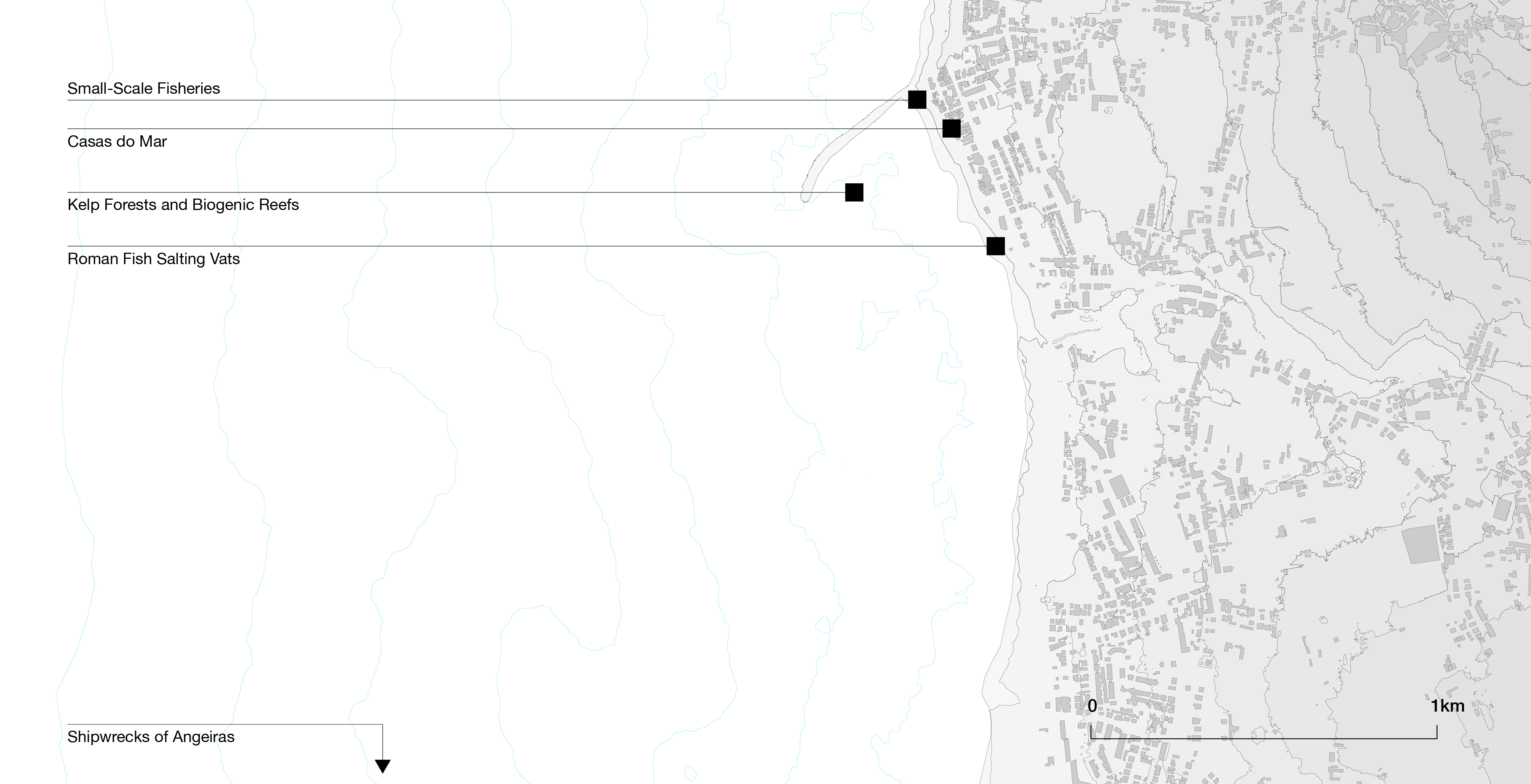
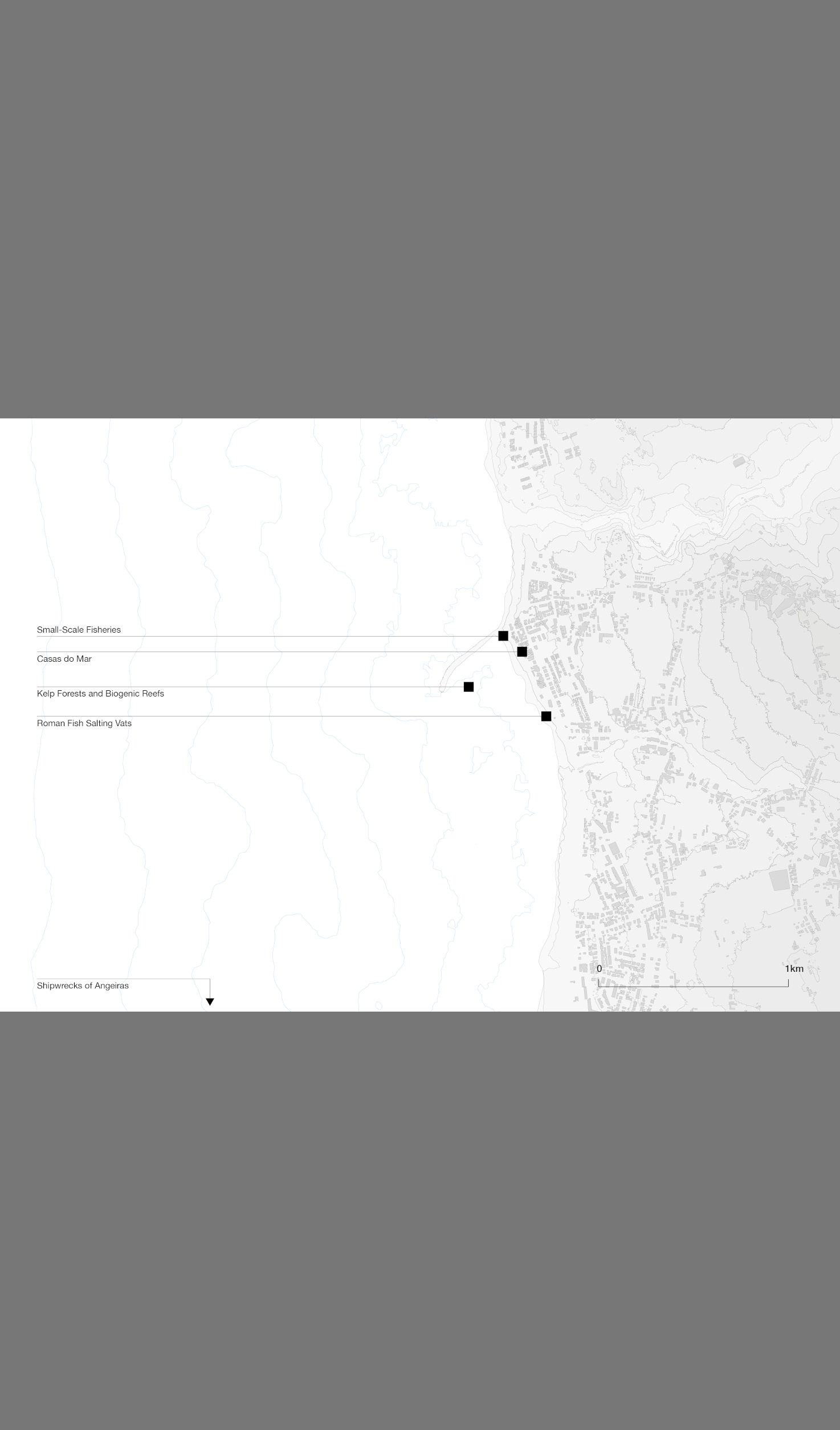
From the Roman fish-salting vats etched into coastal rock outcrops to today’s handcrafted fishing gear, Angeiras bears traces of successive marine economies. These ancient vats—created to produce the fermented fish sauce garum—stand as early evidence of the area’s strategic coastal geography. After a long historical gap, the beach was reoccupied in the early 20th century, initially by peasants collecting sargaço (seaweed) and pilado (small crabs) for use as agricultural fertiliser. The first Casas do Mar—houses of the sea—were built to support this seasonal activity, and later for permanent fishery use as artisanal maritime routines took root. Today, these colourful huts aligned along the shorefront act as both storage and social space, supporting the landing and sheltering of small boats operating directly from the sand. These architectural elements, together with temporary outdoor workspaces, reveal a mode of life that is adaptive yet deeply rooted in local rhythms.
Fishing practices in Angeiras employ a variety of passive gear and traps to target species such as octopus, crab, and conger eel—often from zones known by fisherfolk intimately by name and seabed type. These informal territories, fiercely protected and transmitted across generations, form an invisible underwater landscape, with architectural features such as traps functioning both as harvesting tools and territorial markers. The seabed has become populated with landmarks, such as the remains of a shipwrecked WWII Nazi U-boat near Cabo do Mundo. These productive fishing grounds exist at the edges of kelp forests and biogenic reefs, a space requiring careful navigation and a balance between resource harvesting and ecological care. Angeiras is a living archive of maritime knowledge. Its community embodies a form of resilience attuned to environmental cycles. Here, architecture is not limited to buildings—it includes fishing traps, navigation routes, habitats, and the choreography of boats and bodies over the sand. Reading Angeiras’ layered terrain—from Roman ruins and kelp beds to contemporary work huts and shipwrecks—reveals a dynamic heritage bridging sea and shore, past and future, human and more-than-human worlds.
This complex interplay of ecological, architectural, and economic factors makes Angeiras highly relevant to SEALabHaus’s vision of a transnational laboratory for sustainable blue tourism. The site embodies the values of the New European Bauhaus: sustainability through low-impact fishing and ecological stewardship; inclusion through strong community organisation and cultural transmission; and aesthetics through a deeply rooted, if informal, coastal vernacular shaped by the needs of work and life at sea. In Angeiras, heritage is not merely preserved—it is enacted daily, across sand, stone, and sea.